

Early Identification of SEND: A Comprehensive Guide for Educators
Welcome to our latest exploration into the realm of Special Educational Needs and Disabilities (SEND). In this comprehensive guide, we delve into the intricacies and nuances of early identification in the early years. With heartfelt dedication, we aim to enlighten educators, parents, and care professionals on how to discern and address these needs with empathy and expertise.
The Crucial Role of Early Detection
Detecting SEND at an incipient stage is a cornerstone for crafting a supportive learning environment. It equips us with insights so that we can tailor educational experiences that embrace every child's unique journey. Early detection not only scaffolds individual growth but also fortifies our commitment to inclusive education.
The Importance of Training and Observation
In understanding the nuances of early identification, we recognize the weighty role played by trained professionals within educational settings. Observations carried out by staff—those who interact daily with children—serve as a critical source of evidence when assessing additional needs.
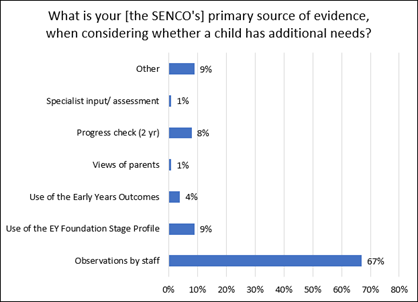 A visual representation highlighting 'Observations by staff' as the primary source for identifying additional needs.
Perceptions from SENCOs
Special Educational Needs Coordinators (SENCOs) play a pivotal role in this domain. Their perspectives provide invaluable insights into both the enabling factors and barriers they encounter when identifying SEN within their settings.
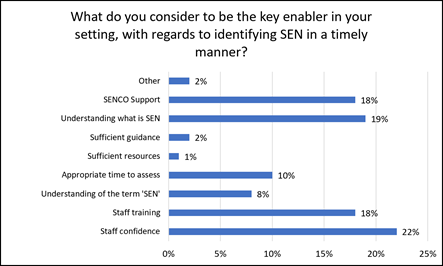 An illustration detailing enablers that assist SENCOs in timely identification of SEN.
- Regularly scheduled meetings for assessment and review
- Ongoing training initiatives for staff awareness
- Maintaining robust systems that facilitate engagement and reporting
A Holistic Approach to Identification
A child's path is best navigated through a holistic lens, one that encompasses discussions with parents, observations within educational settings, and consideration of family dynamics. Such an approach allows us to encapsulate all facets impacting a child's development.
 Youths engaged in developmental play—an opportunity for keen observational insights by caregivers.
Challenges in Early Identification
The task is not without its hurdles. From stretched resources to differing attendance patterns across various early years settings, SENCOs often face constraints when it comes to timely identification and support.
- Financial constraints within settings impacting resource allocation
- Diverse attendance patterns leading to delays in observation and assessment
- Limited access to multi-agency assessments due to lengthy waiting lists
The Voice of Experience: SENCO Frustrations
Oftentimes, SENCOs express 'professional frustration', stemming from their rich understanding being sidelined when compared to multi-agency professionals’ assessments. These tensions highlight the need for greater recognition of on-the-ground expertise.
Recommendations for Progression
The path forward calls for targeted guidance relevant to different early years' settings, fair representation in policy reviews, and enhanced understanding across sectors. Sharing good practices developed by savvy SENCOs can pave the way for truly inclusive environments.
- In-depth job descriptions specific to early years' SENCO roles
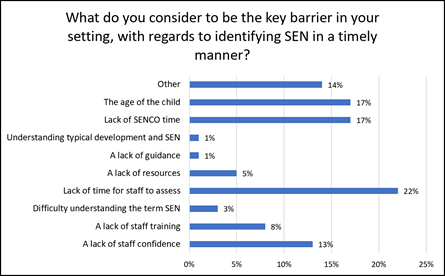 A chart showcasing primary barriers faced by settings when identifying SEND timely.
The Impact of the Pandemic on Childcare Services
The recent pandemic has exerted substantial pressure on childcare services, with a significant number operating at a deficit during lockdown periods. This upheaval necessitates even more inclusive services post-crisis.
Conclusion: The Path Ahead Requires Unity and Understanding
To cultivate an ecosystem where every child flourishes, unity among educators, parents, and various support agencies is paramount. Understanding garnered from studies like nasen’s equips us with knowledge meant not just for contemplation but action. As we strive towards more inclusive futures, let us carry forward these insights with hope and determination.
If you are seeking further enlightenment on this subject or wish to contribute your own experiences regarding SEND in early years education, do reach out via our contact details below:
Teaching Times TrainingPershore Street,
Telephone: +44 121 224 7599
