

Maximizing Professional Growth Through Strategic Peer Observation
Welcome to Teaching Times Training, where we dedicate ourselves to the vital service of raising attainment in educational settings. Nestled in Pershore Street, we are your go-to resource for innovative training solutions. Reach out to us at +44 121 224 7599 for more information and guidance on professional development.
The Transformative Potential of Peer Observation
Peer observation stands as a cornerstone of teacher development—a reflective practice poised to revolutionize the way educators enhance their craft. At Teaching Times Training, we delve into the intricacies of this process, highlighting its impact not only on teachers but also on leaders, managers, and mentors within the educational sphere.
 A group of five colleagues discussing around a table, indicative of collaborative peer observation sessions.
Peer Observation: A Collaborative Endeavor
The essence of peer observation lies in the voluntary and collaborative nature of the experience. It is an opportunity for educators to enter each other's classrooms not as inspectors but as partners in growth. The following are foundational components that shape this approach:
- Reflective practice: Incorporates self-analysis and feedback from peers.
- Coaching and mentoring: Establishes support systems within the school community.
- Autonomy: Allows educators to focus on areas they deem important for their growth.
Distinguishing Different Agendas
A clear demarcation must be made between externally mandated evaluations and those driven by developmental goals. Understanding these distinctions ensures that educators can navigate observations with clarity and purpose.
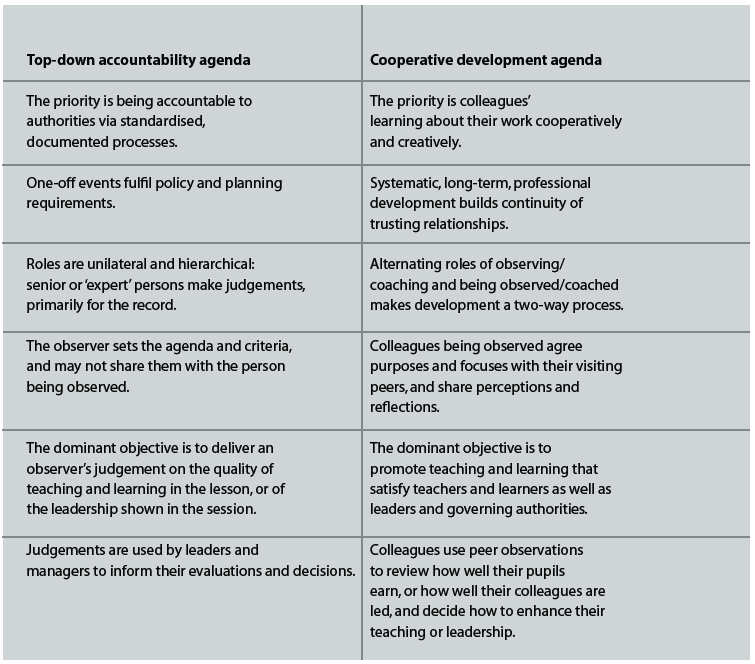 Comparison chart illustrating 'Top-down accountability agenda' versus 'Cooperative development agenda' in peer observations.
Cultivating an Observational Culture
To foster an environment conducive to effective peer observations, strategic considerations must be addressed:
- The role of training groups in supporting observational practices.
- The allocation and use of funding for preparatory activities and subsequent meetings.
- The encouragement of leadership strategies that complement whole-school improvement efforts with professional learning opportunities.
 Three colleagues engaged in a discussion at a table within an academic environment, demonstrating the dynamics of peer interaction during observation feedback sessions.
A Protocol for Success
An explicit protocol serves as a roadmap for successful observations by clarifying objectives, roles, and responsibilities:
- Negotiation of time, place, focus, and format between observers and observees.
- Inclusion criteria for sharing observations with broader audiences while respecting confidentiality agreements.
- The scheduling of feedback sessions promptly following classroom visits or events.
 A classroom scene exemplifying peer observation with students participating actively and an observer taking notes discretely.
Gleaning Insights from Educators’ Experiences
Gathering feedback from those who have engaged in peer observation offers invaluable perspectives on its implementation:
- Educators appreciate both observing others and being observed as it promotes critical reflection and innovation in teaching approaches.
- Mentors emphasize the importance of constructive criticism balanced with positive reinforcement to bolster teacher confidence and skill sets.
- Senior leaders recognize that mutual learning opportunities across hierarchical levels enrich professional knowledge bases significantly.
In Conclusion: Embracing Peer Observation as a Catalyst for Educational Excellence
In embracing peer observation as a regular practice within your institution, you open doors to continuous improvement grounded in collegiality and mutual respect. By engaging teachers at all levels—from newly qualified individuals to seasoned veterans—in reflective dialogue about their practice, everyone advances together towards instructional mastery.
If you're inspired by the potential that strategic peer observation holds for professional development within your school or district, contact us today at Teaching Times Training. We are committed to empowering educators through innovative training methods designed to elevate teaching efficacy and student outcomes alike.
