

Transformative Feedback Strategies for Educators
Welcome to a journey of rethinking educational feedback. At Teaching Times Training, we believe that effective instruction is as much about delivering content as it is about engaging in meaningful dialogue with our students. Professors David Leat and Anders Davidsen have ignited a conversation on how we can leverage formative assessment and feedback to not just inform but transform teaching practices.
The Marking Conundrum
The traditional practice of marking has been lauded for its ability to provide students with tangible assessments of their work. However, this time-intensive task may not always translate into enhanced learning experiences or outcomes. A shift towards strategic feedback can maximize both teaching efficacy and student development while alleviating teacher stress.
Redefining Feedback Beyond Marking
In reconceptualizing feedback, we must distinguish between formal formative assessment—often equated with marking—and the dynamic, informal formative assessment that occurs naturally within the classroom environment. The latter invites immediate engagement and allows for adjustment while ideas are still taking shape, fostering a more responsive and adaptable learning process.
- Formal Formative Assessment: Traditional approaches including written comments, grades, and targets for future performance.
- Informal Formative Assessment: Real-time interaction such as discussions, peer reviews, and on-the-spot questioning.
Leveraging Classroom Dialogue for Feedback
The power of conversation in the classroom cannot be overstated. Neil Mercer's concept of exploratory talk underscores this notion—dialogue isn't just filler; it's an engine driving comprehension and growth. Encouraging rich classroom interactions can illuminate student understanding in ways that traditional marking cannot capture.
Innovative Practices in Informal Formative Assessment
We have gleaned insights from global educational practices that emphasize enhanced dialogic interactions over traditional marking:
 A collaborative classroom where teachers engage closely with students.
- Scotland's Curriculum for Excellence: Action research methodologies have fostered environments where richer dialogues replace extensive marking, thus igniting student enthusiasm and participation.
- The Netherlands' Chemistry Experiment: A study contrasting direct instruction with collaborative discussion found that groups participating in peer dialogue outperformed those who did not, demonstrating the value of shared cognitive processing.
- Mystery Activities: These exercises challenge students to analyze, categorize, and synthesize information through group discussion—providing a fertile ground for immediate feedback and deeper understanding.
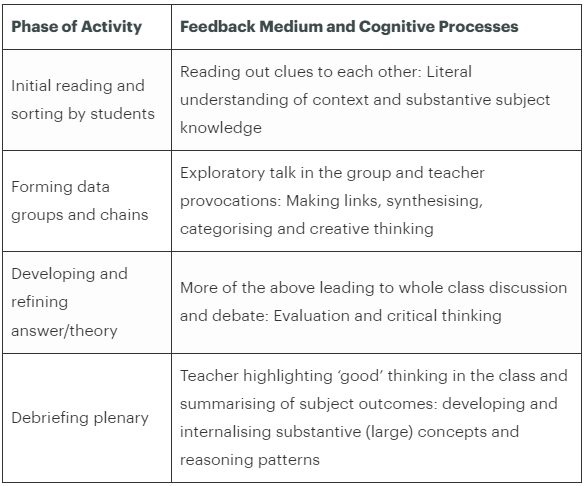 Table outlining phases of activity in Mystery exercises aligned with cognitive processes.
The Professional Development Challenge
Moving away from entrenched assessment practices requires comprehensive professional development. It's vital to explore new pedagogical landscapes thoughtfully to bolster teacher confidence and enhance educational outcomes.
Action Steps for Schools
To embrace these transformative strategies effectively:
- Avoid abrupt changes in assessment policy; gradual implementation fosters greater acceptance and ease among staff.
- Prioritize professional development focused on oracy and collaborative techniques such as think-pair-share exercises.
- Critically evaluate current assessment practices through reflective discussions with leadership teams.
- Observe classrooms where dynamic group interactions occur, noting opportunities for short-cycle formative assessments.
- Incorporate plenary sessions encouraging students to articulate their reasoning, connecting it to broader concepts within the curriculum.
- Experiment with mystery activities known for catalyzing immediate student feedback engagement.
 Teacher engaging one-on-one with a student during classwork.
A Call to Reinvigorate Our Classrooms
We invite educators far and wide to rethink how we provide feedback within our classrooms. Embrace these strategies not only as methods but as philosophies underpinning a holistic educational approach—one where each interaction is an opportunity for growth and transformation. For more information on how you can implement these strategies within your school, reach out to us at +44 121 224 7599 or visit us at Pershore Street. Let us work together to create classrooms that resonate with meaningful exchanges—the kind that shape minds well beyond the pages of any textbook. Warm regards, The Team at Teaching Times Training Pershore Street Contact number: +44 121 224 7599 – Coaching services tailored for educators seeking excellence in teaching practice. Services include Leadership Coaching focusing on emotional intelligence, comprehensive Staff Coaching training programs, and specialized Staff Coaching Children sessions aimed at enhancing listening and questioning skills.
